A successful hair transplant is not judged only by the number of grafts. It is judged by whether the result looks age-appropriate, soft, dense enough and believable. The hairline should not look like a straight wall. It should have natural irregularity, correct direction and a suitable position for the patient's face.
Hair transplant planning must also consider future hair loss. A very low aggressive hairline may look attractive initially but can become unnatural if baldness progresses and donor hair becomes limited.
How Hair Transplant Works
Hair follicles are taken from the donor area, usually the back and sides of the scalp, and implanted into thinning or bald areas. These donor follicles are more resistant to pattern hair loss and continue growing in the new location.
The procedure can be used for male pattern baldness, selected female hair loss, hairline lowering, eyebrow restoration, beard restoration and scar-related hair loss, depending on diagnosis and donor availability.
FUE vs FUT
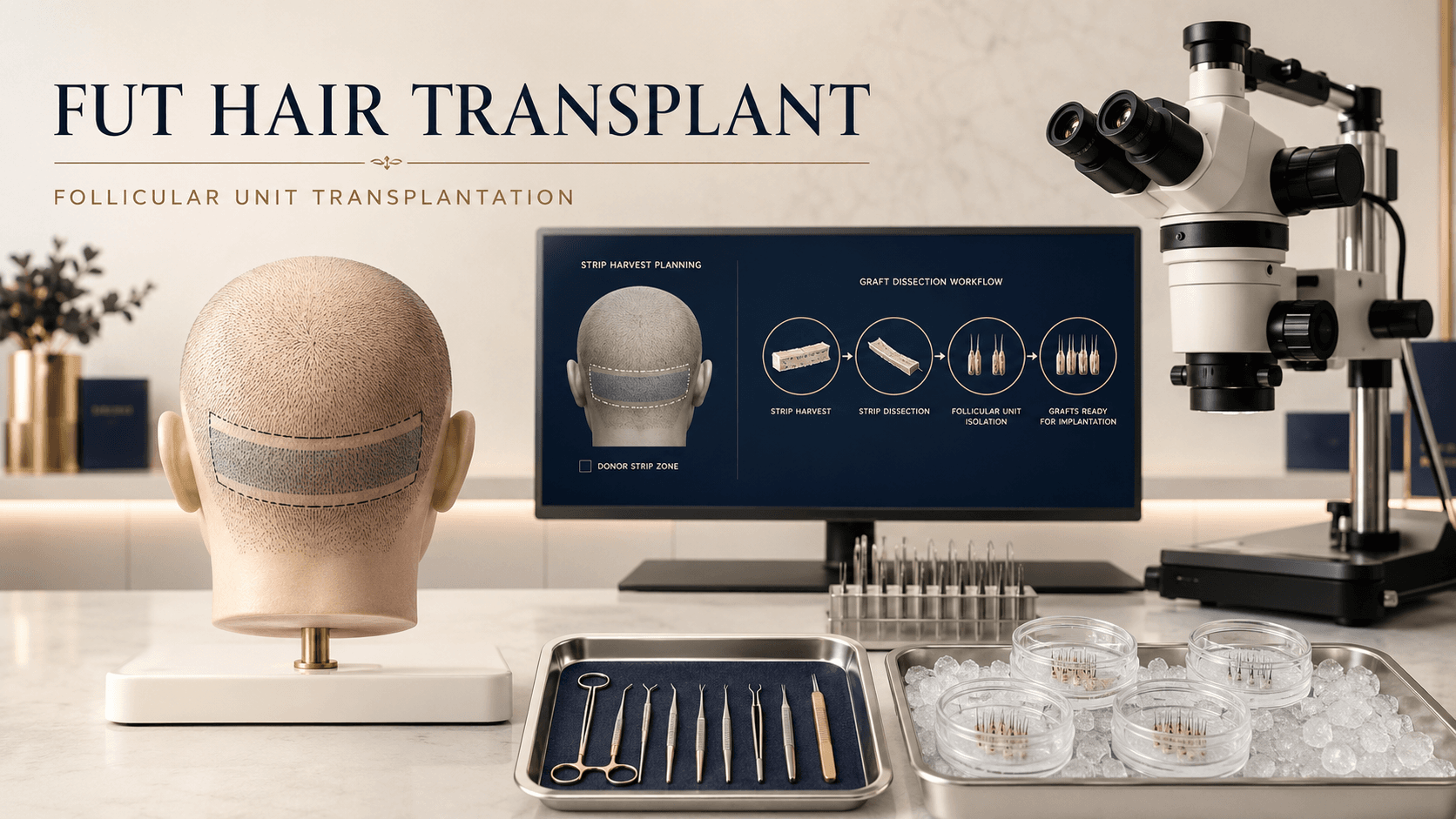
FUE, or Follicular Unit Extraction, removes individual follicular units using tiny punches. It avoids a linear scar and is preferred by many patients who keep short hair. FUT, or Follicular Unit Transplantation, removes a strip from the donor area and dissects it into grafts under magnification.
Neither technique is automatically superior. FUE may be better for short hairstyles and smaller to moderate sessions. FUT may be useful in selected patients needing higher graft numbers or donor preservation. The right choice depends on donor density, scalp laxity, graft requirement, hairstyle and long-term plan.
Hairline Design
Hairline design is both artistic and medical. It considers forehead height, face shape, age, temple recession, hair caliber, ethnicity, donor supply and expected future loss. The front hairline uses finer grafts and careful angulation.
A natural hairline is intentionally irregular. It should frame the face without looking artificial. Overly dense or low hairlines can waste grafts and create future problems.
Donor Management
The donor area is limited. Overharvesting can cause patchiness, visible thinning or depleted donor reserves. Every graft used today must be justified because the patient may need future work.
Good planning balances coverage and density. It may be wiser to create a conservative hairline with good framing rather than chase maximum density in one session.
Recovery and Growth
After surgery, mild swelling, redness and crusting can occur. Patients must follow washing instructions carefully. The transplanted hair shafts often shed within weeks. This is normal and does not mean the grafts failed.
New growth usually begins gradually after a few months. Noticeable improvement often appears around 6 months, with maturation over 9 to 12 months or longer. Crown areas may take longer.
Maintenance of Existing Hair
A transplant fills bald or thinning areas but does not stop ongoing loss of native hair. Medical therapy, PRF, GFC, exosomes, supplements or scalp treatments may be recommended to preserve existing hair and support the overall result.
Patients who ignore maintenance may later develop thinning behind the transplanted zone, requiring additional planning.
Choosing a Surgeon
Hair transplant is a surgical procedure, not a salon service. Natural results require knowledge of hair biology, anatomy, donor safety, graft survival, angles and long-term aesthetics.
Call to Action: For FUE, FUT and natural hairline planning, consult Dr. Chandan Kumar R at Clinique Cutis, Mysore.
Medical note: This article is for patient education and does not replace an in-person consultation. Final treatment suitability depends on medical history, examination and doctor assessment.